
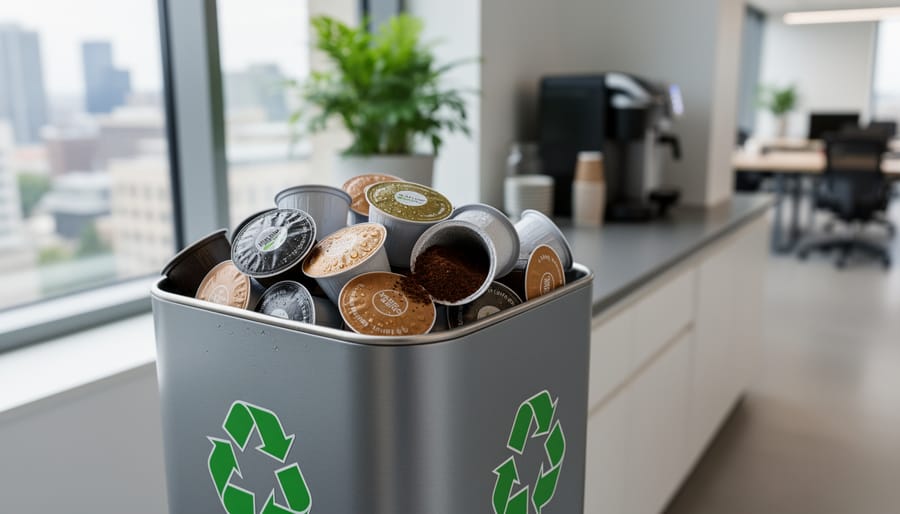
K-Cycle is a workplace recycling service that collects used Keurig K-Cup pods and transforms them into compost and recycled materials, keeping single-serve coffee waste out of landfills. Since its inception, the program has diverted over 7.8 million pounds of pod material from disposal sites, with Canadian businesses alone preventing more than 1.4 million pounds from reaching landfills since 2019.
The initiative matters because K-Cup pods, despite their convenience, create significant waste challenges when tossed in regular trash. These multi-material pods contain plastic, aluminum, organic coffee grounds, and paper filters that don’t break down in landfills. K-Cycle addresses this problem by offering organizations a straightforward collection system that separates and processes each component appropriately, fitting seamlessly into broader Canadian recycling practices aimed at reducing workplace waste.
This article explains how K-Cycle functions, what happens to collected pods, and whether the program makes sense for your workplace. You’ll discover the mechanics behind pod separation, understand the environmental impact backed by verified data, and learn practical steps for implementation. Whether you’re an office manager seeking sustainability solutions or an environmental advocate exploring waste reduction strategies, you’ll find clear answers about turning daily coffee habits into measurable environmental progress.
What the K-Cycle Program Is
K-Cycle is a workplace-focused recycling service that enables Canadian businesses to divert used Keurig K-Cup pods from landfills by converting every component into compost and recycled materials. Unlike municipal curbside programs that typically exclude K-Cups due to their mixed-material construction, K-Cycle provides a specialized solution: businesses collect brewed pods on-site, and the service separates the coffee grounds, paper filter, and plastic housing for complete recovery. The program claims 100% recycling of accepted pods, transforming organic matter into compost while processing the plastic and filter into new products.
This approach mirrors the targeted recovery model used in textile diversion where specialized programs handle materials that curbside bins can’t process effectively. For offices, hospitality venues, and other workplaces where single-serve coffee is a daily ritual, K-Cycle turns what was once a guaranteed waste stream into a measurable environmental win. The service operates on a simple premise: give businesses a hassle-free way to collect pods, then handle the complex separation and processing behind the scenes. That simplicity has proven effective at scale, keeping millions of pounds of mixed plastic and organic waste out of Canada’s landfills while maintaining the convenience that made K-Cups popular in the first place.
How the K-Cycle Program Works
What Happens to the Pod Components
Once collected, each K-Cup pod undergoes a mechanical separation process that treats its three distinct components as separate raw materials. The plastic cup itself gets sorted and directed into recycling streams where it can be reformed into new products. The paper filter, which catches the coffee grounds during brewing, follows a similar path, either recycled as paper fiber or composted alongside the organic material.
The coffee grounds receive dedicated processing as high-quality organic matter. These grounds become nutrient-rich compost that returns valuable nitrogen and carbon to soil systems. Because the pods arrive already brewed, the grounds are clean and ready for composting without additional sorting.
This component-by-component approach is what enables the program’s 100% recycling claim. Rather than treating the pod as a single composite item, which would complicate recycling, the separation technology recognizes that each material has different recovery pathways. The plastic becomes plastic again, the paper returns to fiber or soil applications, and the grounds enrich compost piles. Nothing from a properly collected K-Cup pod ends up in a landfill under this system, turning what was workplace waste into feedstock for new manufacturing and growing cycles.
Collection and Pickup Logistics
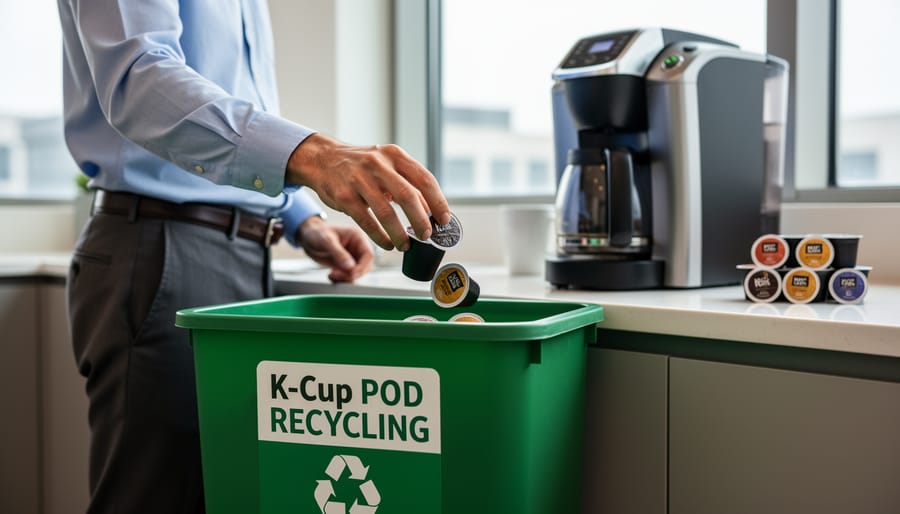
Workplaces participating in K-Cycle receive dedicated collection bins for their break rooms or coffee stations. Employees simply toss brewed pods into these bins throughout the day, no rinsing, separating, or special preparation required. The program is designed to be hassle-free, fitting seamlessly into existing office routines without disrupting workflow.
When a collection bin reaches capacity, the business arranges for pickup. The exact logistics vary depending on the service agreement, but the process is straightforward: filled bins are collected and transported to processing facilities where the separation and recycling work happens. Some workplaces schedule regular pickups based on their pod consumption volume, while others request collection as needed.
The simplicity is intentional. K-Cycle eliminates the barriers that often prevent workplace recycling programs from succeeding. There’s no need for employees to become waste sorting experts or for facilities managers to coordinate complex logistics. You collect, you request pickup, and the program handles the rest. This ease of use is what has enabled Canadian businesses to divert over 1.4 million pounds of material from landfills since 2019, turning daily coffee breaks into measurable environmental action.
Components of the K-Cycle System

The K-Cycle system runs on three essential elements working together: strict acceptance criteria, workplace-based collection infrastructure, and the separation technology that makes complete recycling possible.
What Gets Recycled
The program accepts only brewed Keurig K-Cup pods. Once you’ve made your coffee, that used pod qualifies. Unused pods, packaging, lids removed beforehand, or other coffee waste fall outside the system’s scope. This focused approach ensures the separation process works efficiently.
- Brewed K-Cup Pods
- Used single-serve coffee pods after brewing, containing coffee grounds, paper filter, and plastic housing that K-Cycle accepts for recycling.
- Component Separation
- The technology that splits each pod into its organic, paper, and plastic parts so each material can follow its appropriate recycling or composting path.
- Diversion Rate
- The percentage of material kept out of landfills through recycling; K-Cycle achieves 100% diversion by processing every component of accepted pods.
- Compost Conversion
- The process of transforming organic coffee grounds and paper filters into nutrient-rich soil amendment rather than sending them to waste facilities.
Collection Setup
Workplaces provide the collection point. Businesses receive containers designed specifically for brewed pods, positioned near coffee stations where employees brew their drinks. The system relies on staff dropping used pods into these bins rather than tossing them in regular trash.
The Separation Technology
Once collected, pods move through a separation process that breaks down each unit into its three components. The technology isolates coffee grounds and filters for composting, recovers the plastic for recycling into new products, and ensures nothing ends up as waste. This mechanical separation is what enables the program’s 100% recycling claim and has helped Canadian businesses divert over 1.4 million pounds of material from landfills since 2019.
Where K-Cycle Fits in Canada’s Recycling Landscape
Canada’s recycling system has evolved dramatically over the past two decades, yet it remains fragmented. Curbside programs vary widely by municipality, accepting different materials under different rules. Some communities recycle number 5 plastics; others don’t. Glass gets diverted in one region, landfilled in the next. This patchwork leaves gaps that specialized programs like K-Cycle help fill.
Extended Producer Responsibility (EPR) legislation has pushed manufacturers to take ownership of their products’ end-of-life impact. Ontario’s Resource Recovery and Circular Economy Act and British Columbia’s similar frameworks require companies to manage product waste, shifting responsibility from taxpayers to producers. K-Cycle fits squarely within this philosophy: Keurig-affiliated providers create infrastructure for a product curbside programs can’t handle efficiently.
The same gaps exist elsewhere. Clothing recycling programs emerged because municipal bins weren’t designed for textiles, which now contaminate waste streams and fill landfills. Electronics recycling followed a similar path when provinces mandated take-back systems for devices containing hazardous materials. Specialized streams work because they target specific waste types with appropriate processing technology.
K-Cycle addresses single-use coffee pods consumed in Canadian workplaces, a waste source growing alongside remote work’s decline and office coffee culture’s resurgence. Since 2019, businesses using the program have diverted over 1.4 million pounds of material from landfills. That’s not a complete solution to Canada’s waste challenges, but it demonstrates how focused interventions capture materials that would otherwise slip through. When curbside can’t adapt quickly enough, producer-led programs bridge the divide between consumption habits and available infrastructure.
How Businesses Can Use K-Cycle
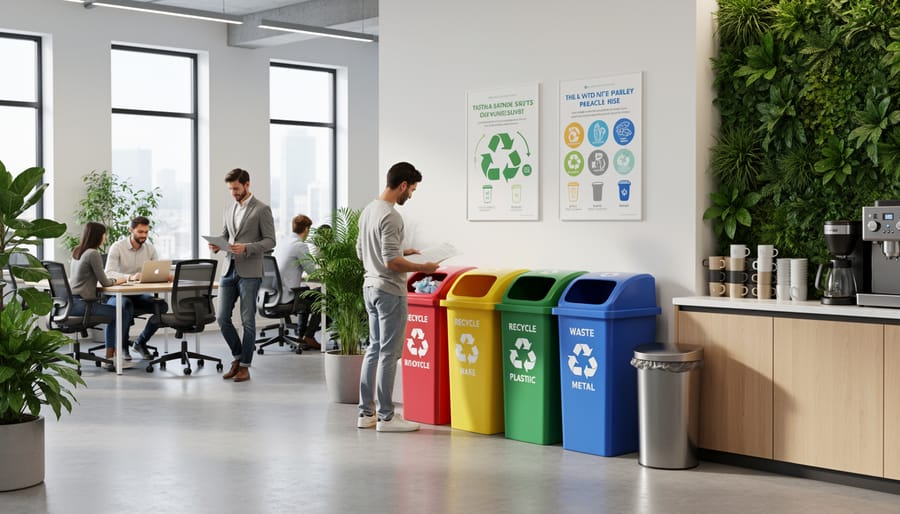
Offices with Keurig brewers stand to gain the most from K-Cycle, particularly those committed to reducing their environmental footprint. The program suits any Canadian workplace where employees consume K-Cup pods regularly, from small firms brewing a dozen pods daily to larger operations running through hundreds.
Different work environments benefit in distinct ways:
- Corporate offices use K-Cycle to meet sustainability targets and demonstrate environmental leadership to clients and employees
- Healthcare facilities reduce medical waste streams while maintaining convenient beverage service for staff working long shifts
- Educational institutions turn daily coffee consumption into a teaching moment about circular economy principles
- Hospitality businesses divert guest room and staff area pod waste while reinforcing their green credentials
The program directly supports corporate sustainability goals by providing measurable waste diversion data. Businesses can track exactly how much material they’ve kept out of landfills, turning coffee breaks into quantifiable environmental action. This matters when reporting to stakeholders or pursuing certifications that require documented waste reduction.
Getting started typically involves assessing your workplace’s pod consumption and setting up collection points near coffee stations. You’ll need somewhere staff can toss used pods after brewing. The simplest approach is designating someone to coordinate the initiative, often a facilities manager or sustainability champion who can gauge interest and handle logistics.
The beauty of K-Cycle lies in its specificity. Unlike general recycling programs that demand complex sorting, this focuses on one item everyone recognizes, making participation straightforward for busy employees who want to contribute without added complexity.
Empowering Your Workplace to Take Action
Starting a recycling program doesn’t require executive authority. You can be the person who brings K-Cycle to your workplace, and the approach is simpler than you might think. Begin by documenting the problem: snap a photo of the overflowing pod bin, estimate how many K-Cups your office uses weekly, and frame it as solvable waste your company is currently sending to landfills. Present this observation to your facilities manager or sustainability lead with a specific ask, not a vague suggestion.
Your pitch gains strength when you connect K-Cycle to environmental initiatives your colleagues already understand. Many Canadians recognize that specialized recycling programs keep textiles out of landfills so positioning pod recycling as the same principle applied to break room waste makes intuitive sense. Emphasize the proven impact: businesses have diverted over 1.96 million pounds through K-Cycle since 2019, which transforms “doing something” into measurable action your company can join.
Most importantly, offer to coordinate the trial period yourself. Volunteering to monitor bin fullness, communicate with staff, and report results removes the barrier of “someone has to manage this.” Climate action at work often stalls not from opposition, but from everyone assuming it’s someone else’s responsibility. Make it yours.
Common Questions About K-Cycle
What is the K-Cycle recycling program?
K-Cycle is a workplace-focused service that collects brewed Keurig K-Cup pods and recycles them into compost and reusable materials, preventing them from reaching landfills.
How does K-Cycle actually work?
Businesses collect used pods in designated bins, which are picked up and taken to a facility where the components, coffee grounds, filter, and plastic, are separated and transformed into compost and recycled products.
What can I put in K-Cycle bins?
Only brewed Keurig K-Cup pods are accepted. Unbrewed pods, packaging, or other coffee-related waste cannot be processed through this program.
How do I get K-Cycle started at my workplace?
Reach out to K-Cycle service providers to inquire about enrollment for your business. The program is designed for Canadian workplaces looking to reduce their single-use waste footprint.
What happens when collection bins are full?
Full bins are scheduled for pickup by the service provider, who transports them to recycling facilities for processing. The logistics ensure minimal disruption to daily workplace operations.
How much waste has K-Cycle diverted?
Since the program launched, over 7.8 million pounds of material have been kept out of landfills. Canadian businesses alone have diverted more than 1.96 million pounds since 2019.
These answers reflect what businesses typically want to know before committing to a recycling program. The impact numbers show real progress, which matters when you’re trying to convince colleagues or decision-makers that K-Cycle delivers results beyond just good intentions. If your workplace generates dozens or hundreds of pods weekly, this specialized system offers a practical path to meaningfully reduce waste in an area where curbside recycling falls short.
K-Cycle represents a straightforward yet powerful example of how specialized recycling programs can address waste streams that traditional curbside systems miss. By diverting millions of pounds of used coffee pods from Canadian landfills since 2019, the program demonstrates that workplace environmental action can deliver measurable results. It fits into a broader shift across Canada toward targeted solutions, like clothing recycling programs and extended producer responsibility, that recognize not all waste requires the same approach.
For individuals, championing K-Cycle at your workplace transforms daily coffee breaks into an opportunity for climate action. For organizations, it turns a visible waste challenge into a sustainability success story. The program’s simplicity removes the usual barriers: no complicated sorting, no behavior overhaul, just collection and conversion into compost and recycled materials.
As you consider K-Cycle, think beyond coffee pods. Your community likely offers other specialized recycling services waiting to be discovered and adopted. Small, concrete steps, recovering textiles, composting organics, recycling single-use items through dedicated programs, add up to meaningful environmental progress. Start with what’s in front of you, whether that’s a bin of brewed pods or another waste stream you encounter daily, and build from there.